
Matthias Surovcik
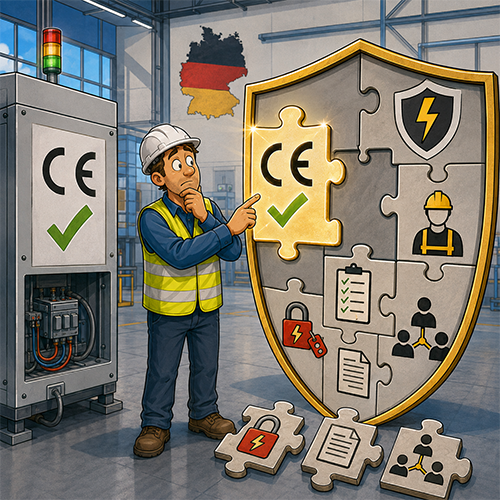
Your company has supplied a production machine for a new German factory. The CE marking is affixed, the EU Declaration of Conformity is available, and the technical file supports the product assessment. The machine can therefore move towards installation. It does not follow that the factory has completed every electrical compliance task required for safe operation.
This distinction matters because product conformity and occupational safety address different decisions. Confusing them can leave a compliant product inside an incomplete operating organisation.
What the CE Marking Actually Confirms
CE marking applies to products covered by relevant harmonised European Union legislation. By affixing the mark, the manufacturer not only indicates but declares that the product meets the applicable requirements. The manufacturer must identify the relevant legislation, complete the required conformity assessment, prepare technical documentation and issue the EU Declaration of Conformity.
CE marking is therefore an important product related statement. It is not a general certificate issued by a central European authority, and it is not evidence that every later installation, workplace or activity is compliant.
The scope of the product remains important. A complete machine, partly completed machinery, an electrical component and an assembly can carry different obligations. The relevant legislation and conformity procedure must be determined for the actual supply.
What the Employer and Operator Must Still Establish
The employer must assess the risks arising from the equipment in its real working environment. The German Ordinance on Industrial Safety and Health requires work equipment to be selected, provided and used safely. The assessment must consider the workplace, work process, interaction with other equipment and the people involved.
The operator must therefore determine how the machine will be accessed, isolated, inspected, maintained and modified. Employees need suitable qualification, instruction and authorisation. Contractors need clear interfaces with the operating organisation.
Electrical installations and equipment must also be maintained and inspected as required for their safe condition. The mandatory DGUV Regulation 3 addresses electrical work and inspections within its scope. These operating duties continue after the product has been placed on the market.
Installation and Integration Can Change the Compliance Context
A machine rarely operates in isolation. It connects to the factory supply, other production systems, data networks, extraction equipment and emergency functions. The installation must address these interfaces and the protective measures required for the complete operating environment.
Integration can also create a larger assembly or change the intended use. Modifications may affect the original conformity assessment. Whether a change is legally significant cannot be decided from its size or cost alone. The effect on hazards, protective measures and intended use must be assessed in the specific case.
The product boundary and the operating boundary should therefore be documented separately. This helps the manufacturer, integrator and operator understand which evidence each party provides and which decisions remain open.
Connect Product Evidence with Operational Evidence
A reliable handover connects both evidence sets. Product evidence includes the Declaration of Conformity, instructions and relevant technical documentation. Installation and operating evidence may include inspection results, settings, risk assessments, work procedures, qualification records and authorisations.
The organisation also needs clear responsibility for future changes. Who assesses a modification? Who approves a change to protective settings? Who determines inspection requirements after repair? These questions cannot be answered by the CE mark printed on the machine.
When the two systems are connected, the result is stronger than either one alone. The manufacturer can demonstrate product conformity, and the operator can demonstrate safe integration and use.
CE marking is an essential element of product compliance where applicable. It is not a substitute for the employer’s electrical safety organisation. The broader Electrical Compliance framework shows how responsibility, qualification, operational control and evidence fit together.
Frequently Asked Questions
Does CE marking prove that electrical equipment is safe to use in Germany?
CE marking indicates that the manufacturer declares conformity with the applicable European Union product legislation. It does not by itself prove that the equipment is safely installed, integrated, operated or maintained in a particular German workplace. The employer must still assess risks, provide suitable work equipment, define safe use and establish inspections. Product conformity and operational electrical safety are connected, but they answer different questions.
Is a separate electrical inspection required after installing a CE marked machine?
An inspection may be required before first use when safe operation depends on installation conditions or assembly, and further inspections may follow from risks, deterioration, exceptional events or legal requirements. The exact scope cannot be determined from the CE mark alone. The employer must identify what needs to be verified in the real operating environment, who is competent to perform the inspection, and how the result is documented.
Who is responsible after a CE marked machine is connected to a German factory?
The manufacturer remains responsible for the product conformity obligations within its role. The employer and operator must address installation, workplace risks, access, isolation, operation, maintenance, inspection and future modification. Integrators and contractors may hold defined contractual and technical duties. Clear product and operating boundaries help every party understand which evidence and decisions it must provide.
Can modifying a CE marked machine affect its conformity?
Yes. A modification can affect the original risk assessment, protective measures, intended use or legal classification. Whether a new conformity assessment is necessary depends on the nature and significance of the change and the applicable product legislation. The decision must be made case by case and documented before the modified equipment is released. Minor operational changes should not be assumed harmless without technical review.
Which records should accompany a CE marked machine at handover?
Relevant product records can include the Declaration of Conformity, instructions and other documentation required by the applicable legislation. Operational handover should also address installation inspection, protective settings, risk assessments, isolation procedures, maintenance requirements, qualification and authorisation. The exact package depends on the machine and its integration. The aim is to connect manufacturer evidence with the information needed for safe use throughout the operating life.
Discuss Your Project
Describe the equipment, integration and operating conditions that must be addressed beyond product conformity. Discuss your project with TCS.